
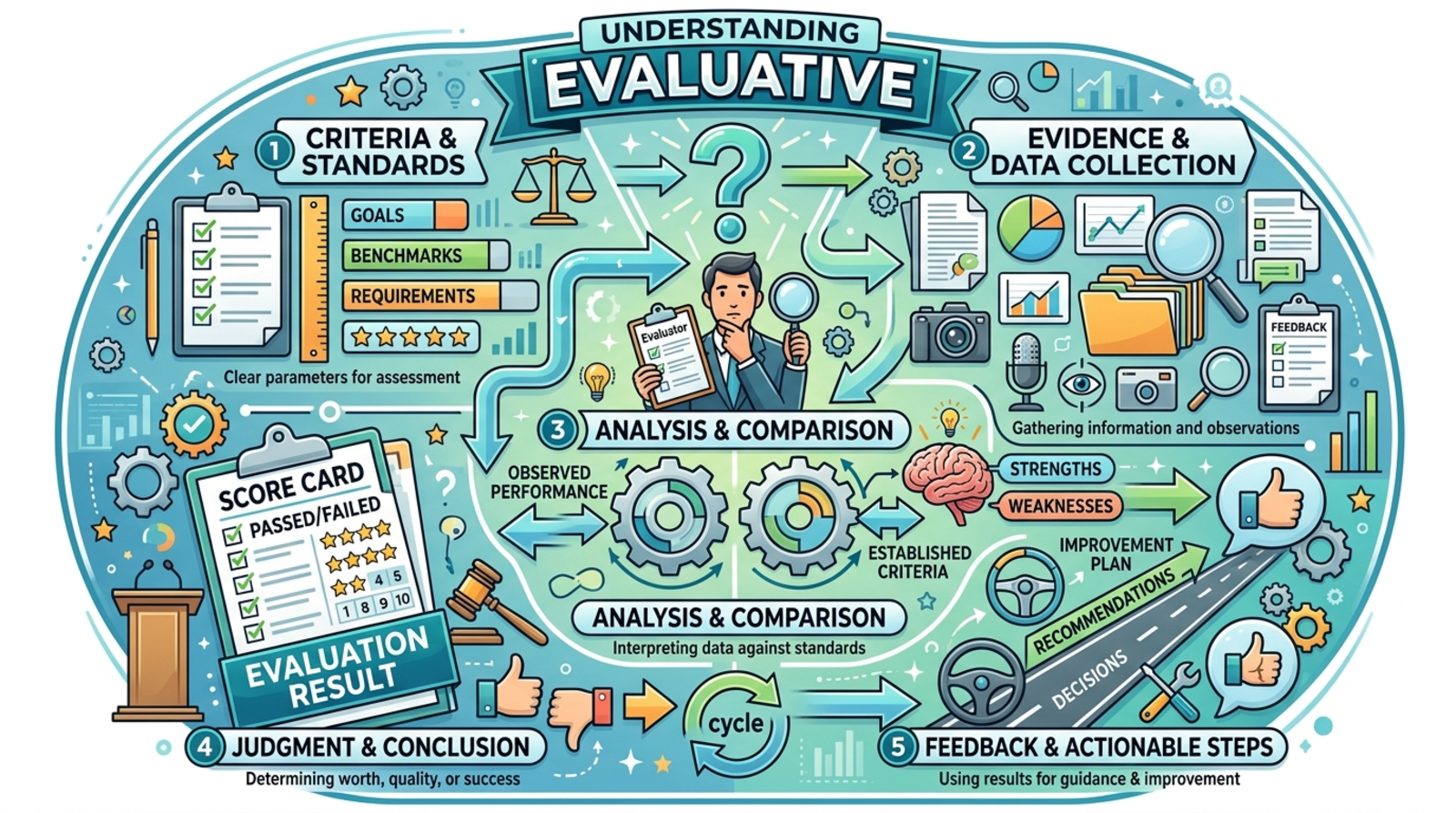
Looking for a synonym for evaluative? The best alternative depends on context. In most situations, words such as analytical, critical, judgmental, assessment-based, appraising, reviewing, interpretive, and diagnostic can replace evaluative. However, each carries a different tone, level of formality, and nuance.
This guide goes beyond a simple synonym list. You’ll learn when to use each alternative, how they differ, which contexts they fit best, and how professional writers choose the most precise word.
Quick Answer: What Is a Synonym for Evaluative?
Evaluative means relating to the assessment, judgment, analysis, or appraisal of something’s quality, value, effectiveness, or performance.
Common synonyms include:
| Synonym | Best Use |
|---|---|
| Analytical | Academic and professional writing |
| Critical | Reviews and assessments |
| Appraising | Formal evaluations |
| Assessment-based | Educational contexts |
| Diagnostic | Identifying strengths and weaknesses |
| Judgmental | Expressing opinions or judgments |
| Review-oriented | Performance reviews |
| Interpretive | Analysis and commentary |
| Comparative | Comparing alternatives |
| Reflective | Personal evaluation |
What Does Evaluative Mean?
The adjective evaluative describes language, thinking, or processes that involve making a judgment about merit, quality, effectiveness, significance, or value.
Examples
- The report contained an evaluative analysis of company performance.
- Teachers use evaluative criteria to grade assignments.
- The article adopted an evaluative approach rather than a descriptive one.
In linguistics, education, business, psychology, research, and communication, evaluative language helps people assess and interpret information rather than merely describe it.
Why Learning Synonyms for Evaluative Matters
Many writers overuse the word evaluative. Using precise alternatives improves:
- Clarity
- Professionalism
- Vocabulary range
- Academic credibility
- Reader engagement
- SEO topical depth
- Communication effectiveness
Choosing the right synonym also helps match audience expectations and tone.
The Evaluative Vocabulary Framework
Instead of memorizing random synonyms, use this Evaluative Vocabulary Ladder.
Level 1: Basic Evaluation
- Reviewing
- Assessing
- Judging
- Rating
Level 2: Analytical Evaluation
- Analytical
- Critical
- Comparative
- Interpretive
Level 3: Professional Evaluation
- Diagnostic
- Appraising
- Performance-based
- Assessment-oriented
Level 4: Advanced Academic Evaluation
- Methodological
- Evidence-based
- Criterion-referenced
- Reflective
This hierarchy helps writers select the most accurate word for the situation.
Core Synonyms for Evaluative Explained
1. Analytical
Definition
Focused on examining details and evidence.
Tone
Objective and professional.
Formality
High.
Best Contexts
- Research papers
- Business reports
- Academic essays
Example
“The researcher provided an analytical examination of the results.”
Difference from Evaluative
Analytical emphasizes examination; evaluative emphasizes judgment.
2. Critical
Definition
Involving careful judgment and analysis.
Tone
Thoughtful and sometimes skeptical.
Formality
Medium to high.
Common Collocations
- Critical review
- Critical analysis
- Critical assessment
Example
“The journal published a critical review of the study.”
Difference from Evaluative
Critical often involves identifying strengths and weaknesses.
3. Appraising
Definition
Assessing value, quality, or worth.
Tone
Professional and formal.
Best Contexts
- Human resources
- Property valuation
- Performance management
Example
“The manager delivered an appraising report on employee performance.”
4. Diagnostic
Definition
Used to identify problems, causes, or areas for improvement.
Tone
Technical and precise.
Example
“The consultant conducted a diagnostic evaluation of operations.”
Difference from Evaluative
Diagnostic focuses on discovering issues, not merely judging outcomes.
5. Judgmental
Definition
Expressing opinions or judgments.
Tone
Often negative.
Example
“The article sounded overly judgmental.”
Usage Note
Use carefully because it may imply unfair criticism.
6. Interpretive
Definition
Explaining meaning or significance.
Tone
Academic and intellectual.
Example
“The essay offered an interpretive perspective on the novel.”
Difference from Evaluative
Interpretive explains meaning; evaluative determines value.
Synonyms by Context
Everyday Communication
Best alternatives include:
- Opinion-based
- Judging
- Reviewing
- Assessing
Example:
“I’m assessing whether this product is worth buying.”
Academic Writing
Recommended terms:
- Analytical
- Critical
- Interpretive
- Reflective
- Comparative
Example:
“The study provides a critical analysis of educational outcomes.”
Business Communication
Effective alternatives:
- Performance-based
- Appraising
- Assessment-oriented
- Diagnostic
Example:
“The company implemented a performance-based review system.”
Leadership and Management
Useful choices:
- Strategic
- Assessment-focused
- Developmental
- Review-oriented
Example:
“The manager delivered developmental feedback during the annual review.”
Marketing and Consumer Research
Appropriate terms:
- Comparative
- Consumer-focused
- Review-based
- Insight-driven
Example:
“The report contains a comparative assessment of competing brands.”
Education and Learning
Common alternatives:
- Assessment-based
- Criterion-referenced
- Reflective
- Diagnostic
Example:
“Teachers use diagnostic methods to identify learning gaps.”
Evaluative vs Related Words
Evaluative vs Analytical
| Evaluative | Analytical |
|---|---|
| Makes judgments | Examines details |
| Focuses on value | Focuses on evidence |
| May include opinions | Often more objective |
Best Choice
Use analytical when discussing examination and evaluative when discussing judgment.
Evaluative vs Critical
| Evaluative | Critical |
|---|---|
| General assessment | Deep examination |
| Neutral tone | Often includes critique |
| Broader meaning | More specific |
Best Choice
Use critical for reviews and in-depth assessments.
Evaluative vs Judgmental
| Evaluative | Judgmental |
|---|---|
| Neutral | Often negative |
| Professional | Personal |
| Objective possibility | Bias implication |
Best Choice
Professional writing generally favors evaluative over judgmental.
Formality Spectrum
Highly Formal
- Diagnostic
- Analytical
- Criterion-referenced
- Appraising
Moderately Formal
- Critical
- Comparative
- Interpretive
- Reflective
Neutral
- Assessing
- Reviewing
- Judging
Informal
- Sizing up
- Weighing up
- Looking over
Choosing the appropriate level of formality improves audience engagement and credibility.
Common Collocations with Evaluative Synonyms
Analytical
- Analytical framework
- Analytical approach
- Analytical review
Critical
- Critical assessment
- Critical commentary
- Critical perspective
Diagnostic
- Diagnostic evaluation
- Diagnostic tool
- Diagnostic process
Appraising
- Appraising performance
- Appraising value
- Appraising effectiveness
Collocations help language sound natural and fluent.
Antonyms of Evaluative
Understanding opposites strengthens vocabulary.
Common antonyms include:
- Descriptive
- Objective
- Neutral
- Factual
- Nonjudgmental
- Observational
Example
Descriptive: The report explains what happened.
Evaluative: The report judges how effective it was.
Common Mistakes When Using Evaluative Synonyms
Mistake 1: Using Judgmental in Formal Reports
Less Effective:
“The research adopts a judgmental approach.”
Better:
“The research adopts an evaluative approach.”
Mistake 2: Confusing Analytical with Evaluative
Analysis is not always evaluation.
A writer can analyze information without making judgments.
Mistake 3: Overusing Critical
Many writers use critical repeatedly.
Alternative options include:
- Analytical
- Comparative
- Reflective
- Diagnostic
- Appraising
Professional Writing Tips
1. Match the Audience
Executives often prefer:
- Strategic
- Performance-based
- Assessment-focused
Academics often prefer:
- Analytical
- Critical
- Interpretive
2. Match the Purpose
If you are:
- Comparing → Comparative
- Judging quality → Evaluative
- Finding problems → Diagnostic
- Explaining meaning → Interpretive
- Examining evidence → Analytical
3. Avoid Repetition
Instead of repeating evaluative several times, rotate relevant alternatives naturally.
Decision Matrix: Which Synonym Should You Choose?
| Goal | Best Synonym |
|---|---|
| Analyze evidence | Analytical |
| Review quality | Evaluative |
| Critique strengths and weaknesses | Critical |
| Identify problems | Diagnostic |
| Assess performance | Appraising |
| Compare options | Comparative |
| Explain meaning | Interpretive |
| Reflect on experience | Reflective |
Frequently Asked Questions
What is the closest synonym for evaluative?
The closest synonym is usually analytical or critical, depending on context. Analytical emphasizes examination, while critical emphasizes assessment and judgment.
Is evaluative a positive or negative word?
Evaluative is generally neutral. It simply indicates that a judgment or assessment is being made. The tone depends on context.
What is an evaluative statement?
An evaluative statement expresses a judgment about quality, value, effectiveness, or importance. For example, “The program was highly successful” is evaluative because it assesses performance.
What is the difference between evaluative and descriptive?
Descriptive language explains facts or observations. Evaluative language judges those facts and assigns value or significance.
Which synonym for evaluative works best in academic writing?
Academic writers commonly use analytical, critical, interpretive, comparative, and reflective because these terms sound precise and scholarly.
Is judgmental a synonym for evaluative?
Yes, but only partially. Judgmental often carries a negative implication of bias or unfair criticism, while evaluative is typically more neutral and professional.
Final Thoughts
Finding the best synonym for evaluative requires more than choosing a similar word. Effective vocabulary selection depends on audience, purpose, formality, emotional tone, and context.
While analytical, critical, appraising, diagnostic, comparative, and interpretive are all useful alternatives, each communicates a slightly different meaning.
The strongest writers don’t simply replace words—they select the precise term that matches their intent. By understanding the relationships among evaluative synonyms, you can communicate with greater clarity, authority, and sophistication in academic, professional, and everyday settings.

Yeh duniya ke sab se mashhoor dramatist aur poet thay. Inhon ne Romeo and Juliet aur Hamlet jaisi famous plays likhin. Unki writing emotions aur human nature ko bohat achi tarah dikhati hai.